


Where I stand
Pregnancy, birth, abortion, loss, feeding, and parenthood do not happen separately from the conditions in which people live. Race, gender, disability, religion, sexuality, income, geography, immigration status, healthcare access, and conflict can all affect whether someone is heard, respected, and able to make decisions about their own body.
Mycelia Birth Co. believes evidence-based care cannot be separated from autonomy, historical honesty, racial and reproductive justice, and human dignity.
You don’t have to share every belief on this page to work with me. Whatever you believe, you’ll get the same respectful, nonjudgmental care. This page is about how I will treat you, not a test you have to pass.
This page shares my values and some history. It isn’t medical, legal, or therapeutic advice. Doula support is non-clinical and works alongside your medical team, not in place of it.
Who is welcome
Everyone. Specifically:
- People of every race, ethnicity, culture, and nationality, and every immigration background.
- People of every religious and spiritual community, as well as people who aren’t religious or spiritual.
- Disabled and chronically ill people, and people who are neurodivergent.
- LGBTQ+ people and families, including transgender, nonbinary, intersex, Two-Spirit, and Indigiqueer people.
- Every family structure and relationship status: single parents, co-parents, married or not, one parent or several, and chosen family.
- People of every income and background.
- Every pregnancy outcome, including miscarriage, stillbirth, and abortion.
- Every feeding decision: chest, breast, bottle, formula, donor milk, pumping, or a mix.
- Every birth decision: hospital, birth center, or home; medicated or unmedicated; vaginal or cesarean.
- Every path to pregnancy and parenthood, including fertility treatment, surrogacy, adoption, and fostering.
Women carry much of the weight of misogyny and gender-based discrimination in healthcare, and I name that plainly. Transgender men, nonbinary people, intersex people, and others also become pregnant, give birth, feed babies, experience pregnancy loss, and need abortion care. I say “women” when something specifically affects women, and use broader words when it affects more people. Neither erases the other.
A note on Two-Spirit: it is an Indigenous term, adopted in 1990 at an intertribal gathering near Winnipeg, and it belongs to Indigenous communities. It isn’t another word for LGBTQ+, and not every nation uses it (Canadian Museum for Human Rights on the origins of Two-Spirit). “Indigiqueer” is a term used and popularized by Oji-Cree writer Joshua Whitehead.
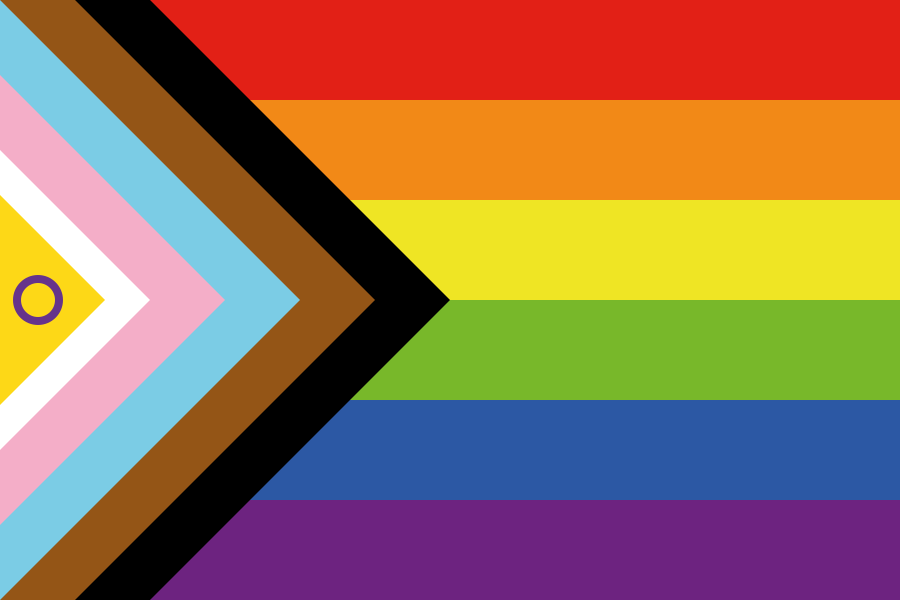
A flag isn’t a policy; the rest of this page is.
What inclusive care means
Inclusion only means something if you can see it in how I work. In practice:
- Your name and pronouns. I use the name and pronouns you give me, and I correct myself if I get them wrong.
- Your words. Tell me the words you use for your family, your body, your pregnancy, your birth, and feeding, and I’ll use them too.
- Consent before touch. I ask before any hands-on comfort measure, every time. “No” or “not now” is always enough.
- Changing your mind. You can decline, pause, or change your mind about anything, without explaining why.
- Faith, culture, and daily life. Religious, spiritual, cultural, dietary, dress, prayer, and modesty needs are part of your plan, not an inconvenience to it.
- Access. Tell me what you need, whether that’s a disability accommodation, a different way to communicate, more time, or written notes. You never have to share a diagnosis or a trauma history to ask.
- Language. If you need an interpreter, I’ll work with you to find language support where it’s available.
- Who’s in the room. You decide who is present in your home and at your birth, and what visitors are told.
- Privacy. I can keep messages and voicemails neutral, and I won’t contact anyone about you without your OK.
- Photos and stories. I never photograph you, or share anything about your experience, without your explicit permission.
- No pressure. I won’t steer you toward an unmedicated birth, a vaginal birth, breastfeeding, formula, parenting, adoption, abortion, or any other particular outcome. My job is to help you decide, not to decide for you.
- When I get it wrong. I listen, take responsibility, and repair what I can (more on accountability).
I won’t promise a perfectly “safe space.” No one honestly can. What I can offer is a safer and accountable space: specific practices you can hold me to.
Black birth, medical racism, and reproductive history
American obstetrics and gynecology did not develop apart from racism; they developed through it. That history matters because it still shapes who is believed in a hospital today. So does the other half of it: Black women’s knowledge, care, and leadership, which kept families alive and still lead the fight for reproductive justice.
Reproduction under slavery
Under slavery, enslavers profited from enslaved women’s childbearing, and the law treated Black women’s reproduction as something owners controlled. After the international slave trade was banned in 1808, births became the main way the enslaved population grew. Enslaved women faced sexual violence and coerced reproduction, and mothers could be separated from their children by sale at any time (legal scholar Dorothy Roberts, Killing the Black Body; College of Charleston, “Reproduction and Resistance”).
Enslaved women also resisted, including with plant knowledge passed down through generations to prevent or end pregnancies.
Medicine built on Black women’s bodies
From 1845 to 1849 in Montgomery, Alabama, Dr. J. Marion Sims performed repeated experimental surgeries on enslaved women, among them Anarcha, Betsey, and Lucy, to develop a repair for vesicovaginal fistula. Anarcha underwent about 30 operations. The surgeries were done without anesthesia, which was not yet in routine use, and without consent that enslaved women had any real power to give (“The Legacy of James Marion Sims,” 2024). Historian Deirdre Cooper Owens shows how early American gynecology was built partly through this work (Medical Bondage, reviewed by AAIHS). In 2018, New York City removed Sims’s statue from Central Park.
Pain that isn’t believed
In a 2016 study, about half of 222 white medical students and residents endorsed at least one false belief about biological differences between Black and white people, such as Black people’s skin being thicker. Those who held more of these beliefs rated a Black patient’s pain as lower (Hoffman and colleagues, PNAS, 2016).
Black midwives: knowledge, care, and displacement
For generations, Black midwives in the rural South attended births in their communities and were central to Black maternal and infant health. Their work was clinical, communal, spiritual, and public-health work all at once. Midwives were not early doulas: they carried medical knowledge and responsibility that the non-clinical doula role does not.
From the 1920s, Southern states used federal Sheppard-Towner Act funds to train, license, and supervise Black midwives. Officials often described them in openly racist terms and blamed them for poor outcomes, and licensing rules gradually pushed them out (TIME, 2024; Center for American Progress, 2020). Margaret Charles Smith of Greene County, Alabama, licensed in 1949, attended thousands of births (Alabama Women’s Hall of Fame). In 1984, Alabama told its remaining lay midwives, among them Onnie Lee Logan of Mobile, that they could no longer practice (Encyclopedia of Alabama).
Segregated care
The 1946 Hill-Burton Act funded hospital construction while explicitly allowing “separate but equal” facilities. A federal appeals court struck that provision down in 1963 in Simkins v. Moses H. Cone Memorial Hospital (NCpedia), and when Medicare began in 1966, hospitals had to desegregate to be paid (KFF Health News).
Eugenics and coerced sterilization
In 1927 the Supreme Court upheld forced sterilization in Buck v. Bell; the decision has never been formally overturned (Encyclopedia Virginia). More than 60,000 people were sterilized under eugenics laws in 32 states, most of them disabled or institutionalized, with poor people and people of color targeted (The Conversation, 2020).
- North Carolina sterilized about 7,600 people between 1929 and 1974, and in its later decades Black women were disproportionately targeted. In 2013 it became the first state to compensate survivors (North Carolina Office of Justice for Sterilization Victims).
- In 1961, civil rights leader Fannie Lou Hamer was given a hysterectomy without her knowledge or consent. The practice was common enough in Mississippi to have a name, the “Mississippi appendectomy” (PBS American Experience).
- In 1973, Minnie Lee and Mary Alice Relf, Black sisters aged 12 and 14, were sterilized at a federally funded clinic in Montgomery, Alabama. Their mother, who could not read, had marked an “X” believing they would receive birth-control shots. The case led to federal informed-consent rules for sterilization (Southern Poverty Law Center).
- By 1965, about one in three mothers of childbearing age in Puerto Rico had been sterilized, often without full information about permanence or alternatives (Harriet Presser, Population Studies, 1969).
- A 1976 federal audit found that the Indian Health Service performed 3,406 sterilizations on Native women in four of its twelve areas between 1973 and 1976, with most consent forms failing federal requirements (US Government Accountability Office).
- In Madrigal v. Quilligan (1978), Mexican-American women sued a Los Angeles hospital over sterilizations performed without informed consent, often during labor. They lost, but the case led to stronger consent protections, including Spanish-language forms (Library of Congress).
- California’s state auditor found that 144 women in state prisons were sterilized between 2005 and 2013, 39 of them without lawful consent (California State Auditor, 2014).
The inequity today
In 2024, the maternal mortality rate for Black women in the US was 44.8 deaths per 100,000 live births, about three times the rate for white women (CDC National Center for Health Statistics, 2026). CDC reviews find that more than 80% of pregnancy-related deaths are preventable (CDC). Racism, not race, drives this gap, and the same myths that let pain go untreated are still part of being dismissed when you say something is wrong.
Black-led work today
Black women named reproductive justice. In 1994, a group of Black women calling themselves Women of African Descent for Reproductive Justice defined it as the right to bodily autonomy, to have children, not to have children, and to parent in safe, sustainable communities (SisterSong). That work continues through SisterSong, Black Mamas Matter Alliance, which founded Black Maternal Health Week in 2018, the National Black Midwives Alliance, and many local Black birth workers (see the resources below).
Where doulas fit
DONA International, founded in 1992, helped formalize one modern model of doula training and certification (ASU Embryo Project). It did not invent continuous emotional, physical, and informational support in labor. Family and community birth workers, especially Black midwives and Indigenous birth workers, carried that knowledge long before the word “doula” was used this way, and as birth work was professionalized, many of them were excluded or pushed out (Center for American Progress).
I’m DONA-trained. That training is one part of a much older history, and I owe that history honesty.
Further reading: Black maternal health and birth equity and Black birth and midwifery history in the resources below.
Reproductive freedom and abortion
On June 24, 2022, in Dobbs v. Jackson Women’s Health Organization, the Supreme Court held that the Constitution does not protect a right to abortion. It overturned Roe v. Wade and Planned Parenthood v. Casey and returned abortion regulation to the states (Supreme Court opinion).
Dobbs didn’t itself ban abortion anywhere. It left each state free to allow, restrict, or ban it, so access now depends heavily on where someone lives, and the laws keep changing (KFF’s current state-by-state tracker). In Pennsylvania, abortion is legal through the end of the 23rd week of pregnancy (before 24 weeks, counted from the last menstrual period). After that, it is allowed only when a physician believes it is necessary to prevent the patient’s death or serious, irreversible harm to their body (18 Pa.C.S. § 3211; Commonwealth of Pennsylvania).
Restrictions fall hardest on people who already face barriers. About half of abortion patients have incomes below the federal poverty line, and Black and Latina women are over-represented among patients (Guttmacher Institute, 2023). Distance from a clinic, disability, being young, immigration status, childcare, housing, work that can’t be missed, violence at home, and the risk of criminalization can turn a legal right into an impossible trip.
What I believe:
- Abortion is part of reproductive healthcare.
- Everyone deserves accurate information, free from coercion and shame.
- I support your autonomy whatever you decide: abortion, miscarriage care, continuing a pregnancy, adoption, birth, or parenting.
- You never need to justify your abortion, to me or to anyone.
- Abortion can bring relief, grief, certainty, ambivalence, sadness, or all of these at once. Every one of those feelings is allowed.
My abortion doula support is non-medical: emotional, practical, and informational support around your care. I don’t provide medical, legal, therapeutic, or emergency services. For medical questions during an abortion or miscarriage, the M+A Hotline connects you with doctors and nurses. For legal questions, the Repro Legal Helpline is free and confidential. In a medical emergency, call 911 or go to the nearest emergency room.
Where to find help, by the kind of help you need
- Medical information
- M+A Hotline: free, private phone and text support from doctors and nurses during a miscarriage or abortion.
- Legal information
- Repro Legal Helpline: free, confidential legal help about abortion, pregnancy, and birth.
- Finding a provider
- AbortionFinder and INeedAnA: directories of abortion providers and support.
- Funding
- National Network of Abortion Funds, and in Pennsylvania the Abortion Liberation Fund of PA.
- Emotional or peer support
- All-Options talkline and Reprocare Healthline.
- Emergency
- Call 911 or go to the nearest emergency room.
Global reproductive rights
Reproductive injustice is global, but it doesn’t take the same form everywhere, and US law and language don’t describe the whole world.
- The World Health Organization estimates that about 45% of abortions worldwide are unsafe, and that restricting abortion doesn’t reduce how often it happens; it makes it less safe (WHO).
- Around 640 million women and girls alive today were married as children (UNICEF).
- In 2019 the UN Special Rapporteur on violence against women reported on mistreatment during childbirth, including procedures without consent, detention over unpaid bills, and lack of privacy, and named it a human-rights issue (summary of the UN report).
- Seven UN agencies jointly condemned forced and coerced sterilization in 2014, noting it still affects disabled people, people living with HIV, Indigenous and ethnic-minority women, and transgender and intersex people (UN Women).
- War makes all of this worse. The UN verified 9,788 cases of conflict-related sexual violence in 2025 and says the true number is far higher (UN News, 2026). Conflict destroys the maternity care, clean water, food, formula, and medicine that pregnancy and newborns depend on, and separates families as they flee (WHO on attacks on health care).
Mycelia’s services are for families in the Philadelphia and Harrisburg areas of Pennsylvania, and virtually for qualifying services. Caring about reproductive justice everywhere doesn’t mean I can offer services everywhere.
Global solidarity
Last reviewed September 21, 2026
Palestine
My position
I stand in solidarity with the Palestinian people. I oppose the genocide in Gaza, and I oppose forced displacement, collective punishment, and the deprivation of food, clean water, shelter, and healthcare. I support Palestinian safety, dignity, freedom, healthcare, and self-determination.
Current reporting (time-sensitive)
Pregnancy and birth have not been spared. As of September 2026, UNFPA reports about 50,000 pregnant women in Gaza, up to 180 births a day, fewer than half of health facilities functioning, and nearly 4,000 pregnancy losses in the first half of 2026 (UNFPA). Famine was confirmed in Gaza in August 2025, and WHO’s Director-General called it man-made (WHO, 2025). It has since been pushed back (UN agencies, December 2025), but most of Gaza’s 2.1 million people remain displaced and short of clean water and medical supplies (UN OCHA, 4 and 11 September 2026).
Findings and legal status
In September 2025, the UN Independent International Commission of Inquiry concluded that genocide is being committed against Palestinians in Gaza, including measures intended to prevent births, such as the destruction of Gaza’s largest IVF clinic (Commission of Inquiry report). Amnesty International and the International Association of Genocide Scholars reached the same conclusion. These findings are disputed, and the International Court of Justice has not yet ruled on the merits of the case brought by South Africa; in January 2024 it ordered measures to protect Palestinians in Gaza from acts of genocide (Human Rights Watch summary), and written pleadings are scheduled to run until 2029 (ICJ). My opposition to genocide is a moral position, informed by these findings. It is not a legal ruling, and I keep the two clearly separate.
Against hatred of any faith
Supporting Palestinian liberation is never hostility toward Jewish people or Judaism. I oppose antisemitism, and I oppose Islamophobia. People of every religious and spiritual community, as well as people who aren’t religious or spiritual, are welcome here.
Relief organizations: see Palestine and humanitarian relief in the resources below.
Other crises
- Sudan. Since April 2023, war has caused the world’s largest displacement crisis (IOM), with nearly 9 million people displaced inside the country. Famine was confirmed in parts of Sudan in 2025, millions still face severe hunger, and UN agencies report widespread sexual violence against women and girls (UNICEF, 2026; UNFPA).
- Democratic Republic of the Congo. In the east, fighting involving the M23 armed group has displaced millions, and a UN Secretary-General report found that sexual violence by M23 against civilians more than doubled between 2024 and 2025 (UN News, 2026).
- Ukraine. WHO has verified more than 3,000 attacks on health care since February 2022, including attacks on maternity hospitals (UN News, 2026).
This is not a complete list of every humanitarian crisis, and a crisis not named here doesn’t mean I don’t care about it. I keep this section short on purpose and review it regularly.
Resources and further reading
Organizations and sources I’ve checked. I’m not affiliated with any of them, and listing them isn’t an endorsement of every position they take. Before donating, please look at each organization’s current work and financial information.
Last reviewed September 21, 2026
Need help now?
- Medical information
- M+A Hotline: free, private phone and text support from doctors and nurses during a miscarriage or abortion.
- Legal information
- Repro Legal Helpline: free, confidential legal help about abortion, pregnancy, and birth.
- Finding a provider
- AbortionFinder and INeedAnA: directories of abortion providers and support.
- Funding
- National Network of Abortion Funds, and in Pennsylvania the Abortion Liberation Fund of PA.
- Emotional or peer support
- All-Options talkline and Reprocare Healthline.
- Emergency
- Call 911 or go to the nearest emergency room.
Mycelia Birth Co. is not an emergency, medical, legal, or crisis service. These organizations are independent.
Black maternal health and birth equity
5 resources
- Black Mamas Matter Alliance (external site)
- Advocacy
- Education
A national network of Black women-led organizations and birth workers working for Black maternal health, rights, and justice. Founders of Black Maternal Health Week.
- National Birth Equity Collaborative (external site)
- Advocacy
- Education
Research, policy, and training to address the Black maternal and infant health crisis.
- Black Women’s Health Imperative (external site)
- Advocacy
- Education
A national nonprofit founded by Black women to advance the health of Black women and girls, including maternal and reproductive health.
- National Black Midwives Alliance (external site)
- Advocacy
- Education
A professional organization led by Black midwives that connects and advocates for Black midwives across the US.
- Aftershock (documentary, 2022) (external site)
- Education
Follows two fathers who lost their partners to preventable childbirth complications and became maternal-health advocates. Contains grief and loss.
Black birth and midwifery history
6 resources
- Midwives: Tradition and Transition (Smithsonian NMAAHC) (external site)
- Education
A museum story on Black midwives in America, how regulation pushed them out, and efforts to revive the tradition.
- All My Babies: A Midwife’s Own Story (1952) (external site)
- Education
A free-to-watch documentary about Mary Coley, a Black midwife in rural Georgia. Contains archival birth footage.
- Medical Bondage, by Deirdre Cooper Owens (external site)
- Education (book)
How American gynecology was built on experiments on enslaved Black women and poor Irish immigrant women.
- Killing the Black Body, by Dorothy Roberts (external site)
- Education (book)
A foundational history of the control of Black women’s reproduction in the US, from slavery to coerced sterilization.
- Birthing a Slave, by Marie Jenkins Schwartz (external site)
- Education (book)
Reproductive medicine and the health care of enslaved women in the antebellum South.
- Birthing Justice, edited by Alicia D. Bonaparte and Julia Chinyere Oparah (external site)
- Education (book)
A collection centering Black women’s voices and birth-justice organizing.
Reproductive justice
4 resources
- SisterSong Women of Color Reproductive Justice Collective (external site)
- Advocacy
- Education
A national collective building the power of Indigenous women and women of color for reproductive justice.
- New Voices for Reproductive Justice (external site)
- Advocacy
- Education
A Black, women- and queer-led reproductive justice organization with offices in Philadelphia and Pittsburgh.
- National Latina Institute for Reproductive Justice (external site)
- Advocacy
A national organization working for reproductive justice for Latinas and Latines.
- If/When/How: Lawyers for Reproductive Justice (external site)
- Legal information
- Advocacy
A national network of lawyers and advocates; runs the Repro Legal Helpline and the Repro Legal Defense Fund.
Abortion providers and access
5 resources
- AbortionFinder (external site)
- Direct services (directory)
A searchable directory of verified US abortion providers and support organizations, updated weekly.
- INeedAnA (external site)
- Direct services (directory)
An independent nonprofit that helps people find clinics, pills by mail, funding, and state-law information.
- Planned Parenthood: abortion access (external site)
- Direct services
Find Planned Parenthood health centers that offer abortion care.
- National Abortion Federation (external site)
- Direct services
- Education
A professional association of abortion providers, with information and a hotline for help finding care.
- Freedom to Choose (Commonwealth of Pennsylvania) (external site)
- Education
Pennsylvania’s official page on abortion rights in the state, with links to funds, doula support, and counseling.
Abortion funds and practical support
3 resources
- National Network of Abortion Funds (external site)
- Funding
- Advocacy
A network of nearly 100 local abortion funds; find a fund near you or donate.
- Abortion Liberation Fund of PA (external site)
- Funding
- Direct services
Financial help, counseling, and information for people who need an abortion, including in Philadelphia, Delaware, and Dauphin Counties. Formerly the Women’s Medical Fund.
- Western Pennsylvania Fund for Choice (external site)
- Funding
Help paying for abortion care, travel, and lodging, and for gender-affirming care, for people from Western and Central Pennsylvania, Ohio, and West Virginia, through its partner clinic in Pittsburgh.
Reproductive legal information
6 resources
- Repro Legal Helpline (external site)
- Legal information
Free, confidential legal help about abortion, pregnancy, birth, and parenting, in every state, regardless of age or immigration status.
- Pregnancy Justice (external site)
- Legal information
- Advocacy
Defends pregnant people facing criminalization tied to pregnancy, pregnancy loss, abortion, or birth.
- Women’s Law Project (external site)
- Legal information
- Advocacy
A Pennsylvania public-interest law organization defending the rights of women, girls, and LGBTQ+ people.
- KFF: Abortion in the U.S. Dashboard (external site)
- Education
A regularly updated tracker of state abortion laws and court cases.
- Guttmacher Institute: State Laws and Policies (external site)
- Education
Research summaries of state-by-state reproductive health laws.
- Center for Reproductive Rights (external site)
- Legal information
- Advocacy
Litigates and campaigns for reproductive rights as human rights, in the US and worldwide.
Miscarriage and abortion medical-information hotlines
3 resources
- M+A Hotline (external site)
- Direct services
Free, private phone and text support from doctors and nurses during a miscarriage or abortion (US).
- All-Options (external site)
- Direct services
A judgment-free talkline for pregnancy decisions, parenting, adoption, abortion, and pregnancy loss, including spiritual care.
- Reprocare Healthline (external site)
- Direct services
Anonymous peer support by phone, text, or Signal for people seeking or having an abortion. Peers, not medical or legal professionals.
LGBTQ+ and gender-affirming reproductive care
4 resources
- Family Equality (external site)
- Education
- Advocacy
Family-building and legal-protection resources and community for LGBTQ+ families.
- National LGBTQIA+ Health Education Center (The Fenway Institute) (external site)
- Education
Training and publications that help health care organizations care well for LGBTQIA+ people.
- Postpartum Support International: Beyond the Binary (external site)
- Education
- Direct services
On pregnancy and parenthood for genderqueer and trans people, with links to support for queer and trans parents.
- interACT: Advocates for Intersex Youth (external site)
- Advocacy
- Education
Advocates for the rights of intersex people, with guides for patients, parents, and providers.
Indigenous, Two-Spirit, and Indigiqueer education
4 resources
- Native Youth Sexual Health Network (external site)
- Education
- Advocacy
By and for Indigenous youth, working on sexual and reproductive health, rights, and justice across the US and Canada.
- 2-Spirited People of the 1st Nations (external site)
- Education
- Direct services
An Indigenous-led organization in Toronto for Two-Spirit and LGBTQ2S+ Indigenous people.
- Bay Area American Indian Two-Spirits (external site)
- Education
- Community
Restoring the traditional roles of Two-Spirit people in Native communities through cultural programs and an annual powwow.
- Indigenous Women Rising (external site)
- Direct services
- Education
An Indigenous-led organization for culturally safe reproductive health options. Its Rain Fund supports Native and Indigenous people seeking abortion care; check its page for current eligibility.
Disability and reproductive healthcare
3 resources
- Sins Invalid (external site)
- Education
- Advocacy
A disability justice movement-building project centering disabled people of color and queer and gender-nonconforming disabled people.
- National Research Center for Parents with Disabilities (Brandeis University) (external site)
- Education
Research and toolkits on parents with disabilities, including disability and pregnancy. (Funding ended August 2026; check current status.)
- Through the Looking Glass (external site)
- Direct services
- Education
Serves families where a parent, child, or grandparent has a disability, including adaptive baby-care equipment.
Palestine and humanitarian relief
3 resources
- Palestine Children’s Relief Fund (external site)
- Donations
- Direct services
Medical and humanitarian relief for children in Gaza and the West Bank, including surgical missions and mental-health support.
- Medical Aid for Palestinians (external site)
- Donations
- Direct services
A UK charity delivering health and medical care to Palestinians in Gaza, the West Bank, and refugee communities. Donations may not be US tax-deductible.
- Doctors Without Borders (MSF): Palestine (external site)
- Donations
- Direct services
Trauma, burns, surgical, and mental-health care in Gaza and the West Bank. US donors: doctorswithoutborders.org.
Global women’s and reproductive rights
6 resources
- UNFPA (external site)
- Education
- Advocacy
The UN’s sexual and reproductive health agency.
- World Health Organization: abortion (external site)
- Education
WHO’s evidence summary on abortion and safe care.
- UN Women (external site)
- Education
- Advocacy
The UN body for gender equality and women’s human rights.
- Equality Now (external site)
- Advocacy
- Legal information
Works for legal and systemic change to end violence and discrimination against women and girls worldwide.
- MADRE (external site)
- Advocacy
- Donations
Partners with grassroots women’s rights organizations worldwide.
- Ipas (external site)
- Direct services
- Advocacy
Expands access to abortion and contraception by strengthening health systems and local groups worldwide.
Accountability and feedback
Mycelia aims to provide a safer and accountable space. I may not always get everything right. If I make a mistake, I am committed to listening, taking responsibility, repairing harm where possible, and continuing to learn.
If something on this page is wrong, out of date, or missing, or if I’ve let you down in your care, please tell me. You can send a message through the contact page or email contact@myceliabirth.com. If you’re a client, you can also use the feedback page in your client portal. You never have to explain why you’re raising something.
Page last reviewed September 21, 2026. Time-sensitive sections are reviewed every three months.